Website Development Cost in India (2026 Guide)
Budgeting for a website in India is harder than it should be because nobody quotes honestly upfront. This guide breaks down real costs by project type — so you can go into conversations with developers knowing what things actually cost.
The most common answer to "how much does a website cost in India?" is "it depends." That's true, but it's also not very useful when you're trying to budget.
Here's what actually depends, and on what.
Why website costs vary so much in India
A website is not a single product — it's a combination of design, development, content strategy, and ongoing maintenance. The price varies based on which of those things you're paying for and who's doing it.
Scope and functionality A 5-page brochure site and a 200-product ecommerce store are both "websites," but they require completely different amounts of work. The gap in complexity justifies a 10× difference in price. Who builds it A freelancer charging ₹20,000, a small local agency charging ₹80,000, and a product-focused studio charging ₹3,00,000 can all build you a "business website." The difference is experience, process, and what happens when something goes wrong later. Platform choice WordPress, Shopify, Next.js, Webflow, and custom-built systems have very different development costs and very different ongoing maintenance costs. Platform choice affects both the initial project price and what you pay over the next three years. Design from scratch vs template Custom design — where a designer builds your visual system from a blank canvas — costs substantially more than customising a premium theme or template. Both can produce good results; the difference is how unique the output is and how well it fits your specific brand.
Cost by website type in India (2026)
Here are realistic price ranges broken down by project type. These are for professional work — not the ₹5,000 Fiverr site, but also not the ₹20 lakh enterprise project for a startup that doesn't need one.
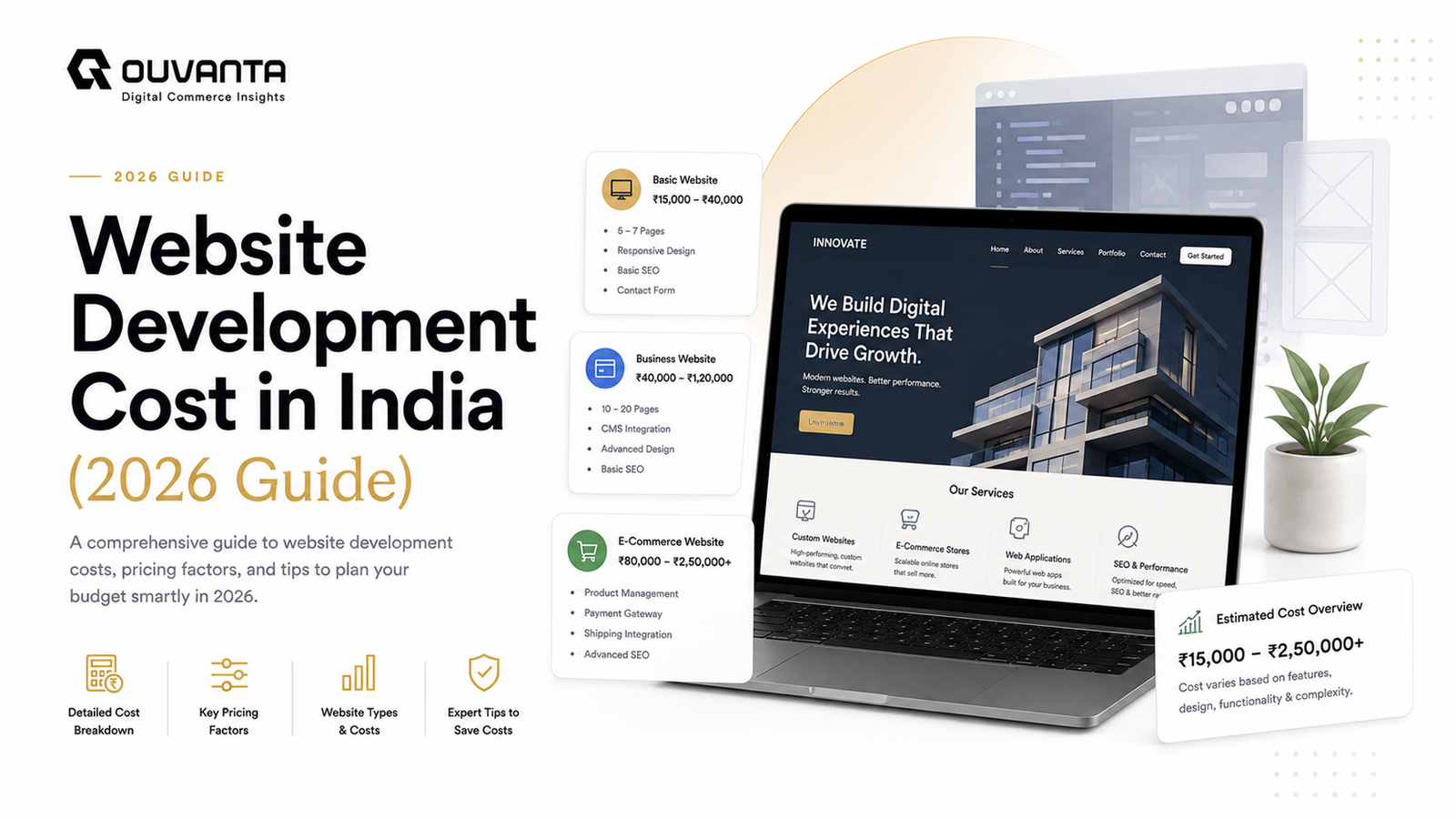
Basic business / brochure website What you get 5–8 pages, contact form, mobile responsive, basic SEO setup. Typically template-based with your branding applied. Typical cost ₹15,000 – ₹60,000 Right for Local service businesses, small clinics, early-stage startups that need a credible online presence. Professional service / lead generation website What you get 10–20 pages, service pages, conversion-focused design, proper CMS, lead capture forms, analytics setup, basic performance optimisation. Typical cost ₹60,000 – ₹2,00,000 Right for Agencies, consultancies, professional practices, B2B businesses where the website is the primary lead generation channel. Ecommerce website (small to mid catalogue) What you get Product catalogue up to 500 SKUs, checkout, payment gateway integration (Razorpay, PayU), order management, mobile optimisation. Typical cost ₹80,000 – ₹3,50,000 Right for D2C brands, retailers, artisan businesses, anyone selling physical or digital products online. Shopify development sits in this range. Custom web application What you get Custom logic, user authentication, dashboards, integrations with external systems, bespoke database structure. More software than website. Typical cost ₹3,00,000 – ₹15,00,000+ Right for SaaS products, platforms with user accounts, booking systems, marketplace products, anything requiring custom workflows.
What drives the price up
When you get quotes that vary wildly, these are usually the factors creating the gap:
- Custom design vs template. A bespoke design from a UI designer adds ₹30,000–₹1,50,000 to a project depending on complexity. Templates with your branding applied are cheaper and often look fine — but they're also used by thousands of other businesses.
- Content writing. Copywriting is frequently excluded from website quotes. If you need a developer to also source and write all content, that's 20–40 hours of additional work.
- Integrations. CRM integration, accounting software, payment systems, booking calendars — every third-party integration adds scope and testing time.
- Speed and performance optimisation. A fast website requires deliberate technical choices. Some developers deliver these by default; others don't. Asking about Core Web Vitals scores before signing a contract is worthwhile.
- Multilingual support. English-and-Odia or English-and-Hindi websites require translation workflows and often CMS configuration that adds significant development time.
Platform choice and cost implications
The platform your website is built on affects both the upfront cost and what you pay for the next three to five years.
WordPress The most common choice for business websites in India. Lower initial build cost. But it requires ongoing maintenance — plugin updates, security patches, hosting management. Annual cost for a properly maintained WordPress site: ₹12,000–₹40,000 in hosting and maintenance. Shopify The standard for D2C ecommerce in India. Monthly subscription of ₹1,700–₹8,500/month (₹20,000–₹1,00,000/year). No hosting to manage. The platform handles security and updates. Better total cost of ownership for most ecommerce businesses than self-hosted WooCommerce. Next.js (custom) Higher initial development cost. Significantly faster performance. Best choice for businesses where website speed is a competitive advantage — high-traffic lead generation sites, performance-critical applications, or businesses investing in SEO. Hosting on Vercel runs ₹0–₹8,000/month depending on traffic. Webflow Design-heavy no-code platform. Lower development cost than custom code. Higher ongoing hosting cost (₹1,500–₹5,000/month). Good for marketing teams that need to update content frequently without developer help.
For ecommerce-specific platform decisions, the Shopify development cost guide covers costs and trade-offs in detail.
Costs that don't appear in the initial quote
The quoted development cost is often just the beginning. Budget for these as well:
Ongoing costs to include in your budget Hosting ₹3,000 – ₹40,000/year depending on platform and traffic. Shared hosting is cheap but slow. A proper VPS or managed WordPress host costs more and performs significantly better. Domain renewal ₹800 – ₹2,500/year for a .com or .in domain. A small cost but one that's easy to miss until the domain expires. SSL certificate ₹0 – ₹12,000/year. Most hosting providers now include free SSL via Let's Encrypt. If yours doesn't, this is table stakes for any professional website. Annual maintenance ₹10,000 – ₹50,000/year for WordPress. Covers plugin updates, security monitoring, backups, and small content changes. Often skipped — and then the site breaks after an update. Content updates If you don't have a CMS that lets you update content yourself, budget for developer time whenever you need copy or image changes.
The real cost of cheap websites
The ₹8,000 website from a local freelancer sounds like a bargain. Sometimes it is. More often, it delivers a site that:
- Loads slowly (3–5 seconds) because performance optimisation wasn't in scope
- Breaks on mobile because responsive design wasn't prioritised
- Has no clear conversion path and generates zero leads
- Can't be updated without calling the developer
- Has no proper SEO setup and doesn't appear in searches
The downstream cost of a non-converting website isn't the ₹8,000 you paid. It's the months of ad spend you poured into a site that couldn't convert the traffic, and the eventual cost of rebuilding it properly.
A website's value isn't measured in how good it looks — it's measured in how many enquiries it generates. A well-built ₹1,50,000 website that converts 3% of visitors is worth more than a beautiful ₹50,000 site that converts 0.5%.
Finding the right development company
When evaluating development companies or freelancers for your project, the questions that actually help:
- Can you show me websites you've built that generate leads or sales? Portfolio work should demonstrate business outcomes, not just visual design.
- What's the performance score on your recent projects? Ask for a PageSpeed Insights score from a recent project. A serious developer will know this number.
- What CMS will I use to update my own content? You should be able to update text and images without developer involvement. If the answer is "call us," reconsider.
- What does the handover include? Documentation, training, access credentials, and who to call when something breaks are all part of a professional delivery.
- What happens after launch? Bugs happen. Clarify the warranty period and what support looks like six months post-launch.
For businesses in Bhubaneswar specifically, our article on choosing a website development company in Bhubaneswar covers what to look for in local providers.
Our website development service builds high-performance sites in Next.js and handles both the development and the conversion strategy. If you have a project in mind, book a free consultation and we'll give you an honest scope and cost estimate within 48 hours.
Questions people ask
Website development costs in India range from ₹15,000 for a basic brochure site to ₹15,00,000+ for a custom web application. A professional business website for a service company typically costs ₹60,000–₹2,00,000. Ecommerce sites (Shopify, WooCommerce) run ₹80,000–₹3,50,000 depending on catalogue size and features.
The gap comes from scope, platform choice, design approach, and who's doing the work. A freelancer building a WordPress template site works differently from an agency building a custom Next.js application. Both produce 'websites.' The difference is performance, conversion focus, and what happens after launch.
WordPress is better for content-heavy or service businesses that need a flexible CMS. Shopify is better for ecommerce — it handles hosting, security, and updates without your involvement, which makes the true total cost of ownership competitive with WordPress once you factor in maintenance. The right choice depends on your business type.
Budget for hosting (₹3,000–₹40,000/year), domain renewal (₹800–₹2,500/year), annual maintenance if on WordPress (₹10,000–₹50,000/year), and any content update costs. These are frequently missing from initial quotes and catch businesses by surprise.
A basic brochure site typically takes 2–4 weeks. A full lead generation website with custom design takes 4–8 weeks. An ecommerce site takes 6–12 weeks. Custom applications take 3–6+ months. Timeline depends on how quickly you can supply content, provide feedback, and make decisions — delays on the client side are the most common reason projects run late.
Look for evidence of business outcomes, not just visual portfolios. Ask for PageSpeed scores on recent projects. Ensure you'll have a CMS that lets you update content yourself. Clarify what post-launch support looks like. A company that can explain their conversion strategy — not just their design process — is usually a safer choice.
Share this article
If you want this done for you
Sources
Platform behaviour and thresholds referenced above come from the official documentation. Cost figures are drawn from live accounts in the Indian market and are stated as bands, not averages.
- Core Web Vitals — the thresholds and how they are measured — web.dev, Google
- Lighthouse performance scoring — Chrome Developers
- WordPress hosting requirements — WordPress.org