Meta Ads Cost in India (2026): What You'll Actually Pay
Most businesses don't have a lead problem. They have a tracking problem. Here's what Meta Ads actually cost in India right now — and why the number you're watching probably isn't the one that matters.
Every month, businesses across India spend money on Meta Ads without being able to answer a simple question: is this working?
The usual answer is to look at cost per click, decide it's too high or too low, and either keep spending or give up. Neither approach is right.
This guide covers what Meta Ads actually cost in India in 2026 — CPM, CPC, and cost per lead across different industries — and more importantly, which numbers actually tell you whether your spend is working.
Why Meta Ads costs vary so much
Before any benchmark, understand this: Meta runs an auction. You're not buying ad space at a fixed price. You're bidding against other advertisers for attention from specific people, and the price changes continuously based on demand.
This means two businesses in the same industry can have completely different costs for the same audience. What drives those differences:
Audience size and specificity A narrow audience of 50,000 people in Bhubaneswar costs more per impression than a broad audience of 5 million across India — because you're competing with fewer advertisers for the same eyeballs, but each one is more valuable to you. Ad creative quality Meta scores your ads for relevance. High-quality creatives that generate clicks and engagement get cheaper distribution. Low-quality ads that people scroll past cost more — Meta's algorithm actively charges you a premium for boring ads. Time and competition Festive seasons (Diwali, Dussehra, Holi, year-end) drive CPMs up 40–80% as every brand increases spend simultaneously. If you run a campaign in October, you'll pay more than the same campaign run in March. Placement Facebook Feed typically costs more than Instagram Stories, which costs more than Audience Network (external apps and websites). Most campaigns use Advantage+ placements, which blends costs across all placements. Objective Campaigns optimised for Lead Generation or Purchase have different cost structures than those optimised for Traffic or Reach. Meta spends more efficiently when it has a clear conversion signal to optimise toward.
None of this means benchmarks are useless. They're useful starting points — but treat them as reference ranges, not guarantees.
CPM benchmarks in India (2026)
CPM — cost per 1,000 impressions — is the base cost of buying attention on Meta. Everything else is derived from this number.
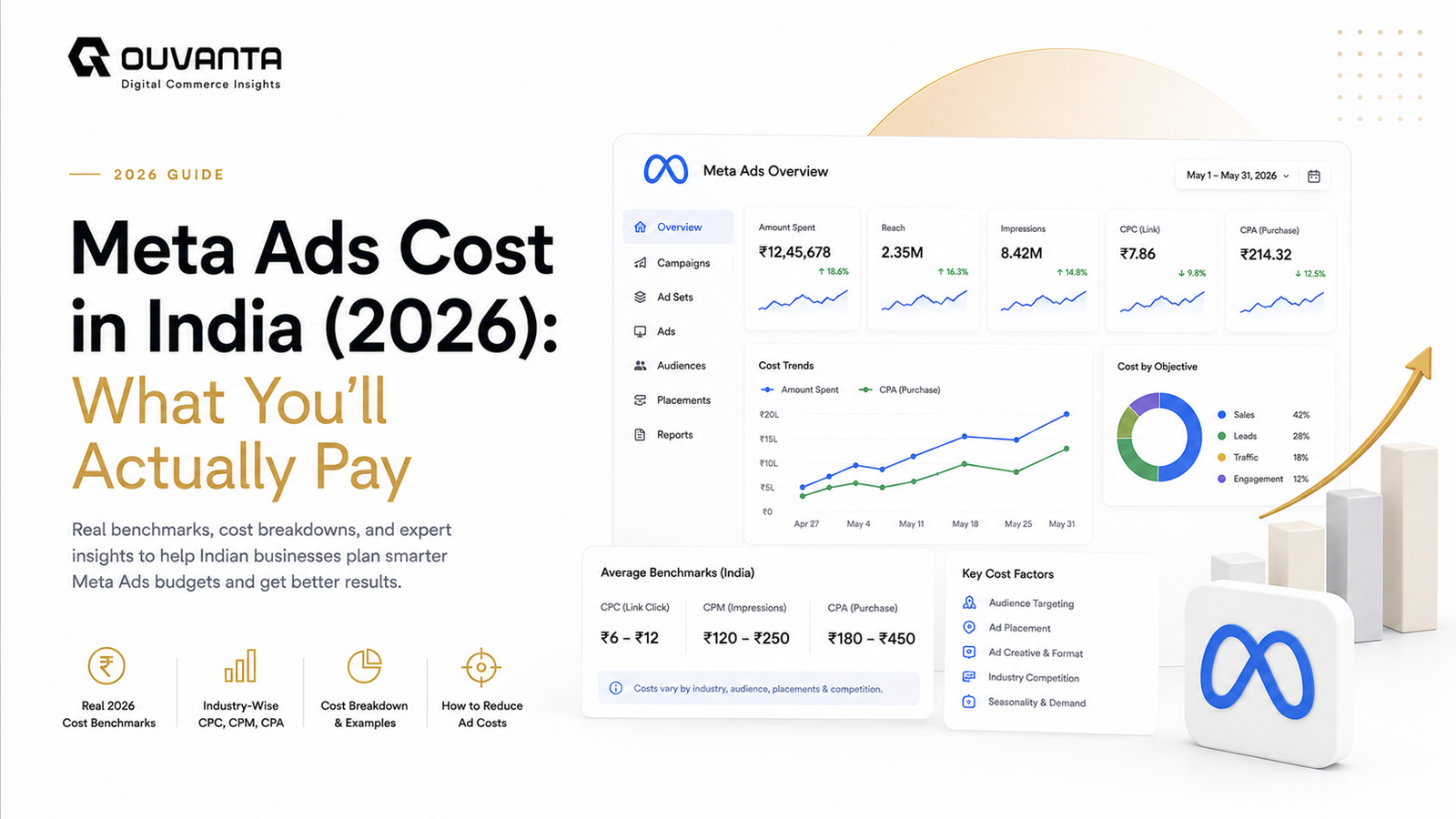
Average CPM ranges in India Broad audiences (interest-based, 1M+ reach) ₹60 – ₹120 per 1,000 impressions Mid-size audiences (layered interests, 200K–1M) ₹100 – ₹200 per 1,000 impressions Narrow audiences (lookalikes from customer lists, retargeting) ₹150 – ₹320 per 1,000 impressions Festive season premium (Oct–Dec) Add 40–80% to any figure above
India has lower CPMs than the US or UK because the market has historically lower disposable income and because Meta's ad inventory was for years underpriced here. That gap is closing as more Indian businesses adopt Meta advertising. CPMs have risen steadily.
What CPM actually tells you
On its own, not much. A low CPM just means you're reaching people cheaply. If those people never buy, a ₹60 CPM is more expensive than a ₹300 CPM that delivers real customers.
The metric that matters is what happens after the impression — click rate, landing page conversion, and ultimately cost per lead or cost per sale.
CPC benchmarks in India (2026)
Cost per click depends on CPM and click-through rate. If CPM is ₹120 and your click-through rate is 2%, you're paying ₹6 per click. If CPM is ₹120 and your CTR is 0.5%, you're paying ₹24 per click.
Industry benchmarks for CPC in India:
CPC by category Consumer goods, fashion, FMCG ₹3 – ₹12 per click Education and coaching ₹8 – ₹25 per click Real estate ₹15 – ₹55 per click Healthcare and wellness ₹10 – ₹40 per click B2B services and consulting ₹20 – ₹80 per click Finance and insurance ₹25 – ₹100 per click
A cheap click from a mismatched audience is the most expensive click you can buy. The cost shows as ₹5 in Ads Manager. The cost in wasted sales calls and zero-conversion pipeline is much higher.
Don't optimise for the lowest CPC. Optimise for the lowest cost per qualified lead or purchase. Those numbers often move in opposite directions.
Cost per lead by industry in India
This is the metric that matters for most service businesses. What does it cost to get a specific person to raise their hand and say they're interested?
Average cost per lead (Meta Ads, India) Home services (interior design, renovation, solar) ₹150 – ₹600 per lead Real estate (residential) ₹300 – ₹1,500 per lead Education and online courses ₹80 – ₹350 per lead Healthcare (clinics, hospitals) ₹120 – ₹500 per lead Financial services ₹200 – ₹800 per lead B2B SaaS and agencies ₹400 – ₹2,000 per lead Ecommerce (first purchase) ₹250 – ₹900 per acquisition
These ranges are wide because they depend heavily on the offer quality, the landing page, and how well the targeting matches real buyers rather than people who happen to fit a demographic profile.
The question your benchmark needs to answer: If your average order value or lifetime customer value is ₹X, how much can you afford to pay for a lead while staying profitable? That number — not the industry average — is your real target.
What budget do you actually need?
There's no honest answer to this that doesn't depend on your business. But here's the reasoning that leads to a realistic number.
Meta's algorithm needs data to optimise. It needs around 50 conversion events per week at the ad set level before it exits the "learning phase" and starts delivering reliably. Below that, the algorithm is essentially guessing.
For a lead generation campaign with a cost per lead of ₹300–₹500, getting 50 leads per week requires roughly ₹15,000–₹25,000 per week — which means ₹60,000–₹100,000 per month in ad spend just for the algorithm to work properly.
In practice, most businesses in Bhubaneswar and smaller Indian cities can work with lower spend because the audience is smaller and the competition is less intense:
₹10,000 – ₹20,000/month Testing territory. You'll get some data but the algorithm won't optimise efficiently. Useful for early creative testing, not for scaling. ₹25,000 – ₹50,000/month Viable for most local service businesses targeting a specific city or region. Enough for the algorithm to learn and for you to see what's working. ₹75,000 – ₹2,00,000/month The range where Meta Ads starts to compound. Multiple campaigns, proper A/B testing, and the budget to act quickly on what works. ₹2,00,000+/month Serious growth mode. Full-funnel advertising — cold, warm, and retargeting audiences — with enough budget to test, learn, and scale systematically.
If you're starting with less than ₹25,000/month, consider whether paid advertising is the right channel yet. At that level, organic strategies, referrals, or Google Ads (which doesn't require the same volume of conversions to work) might give you better returns.
How to reduce your Meta Ads costs
Most cost reduction in Meta Ads comes from improving three things — none of which involve reducing your budget.
Improve your creative
This is the single biggest lever. A creative with a 3% CTR costs roughly 6× less per click than the same audience with a 0.5% CTR. Better creative doesn't mean more polished — it means more relevant, more specific, and more honest about what you're selling and who it's for.
Test video against static. Test problem-led hooks against product-led hooks. Test user-generated content against designed ads. The gap between a poor creative and a great one can cut your cost per lead in half.
Fix the post-click experience
Most businesses focus exclusively on the ad and ignore what happens after the click. A landing page that converts at 3% is dramatically different to one that converts at 10%, even with identical ad costs. The second one delivers 3× more leads from the same spend.
Your landing page should have one clear offer, one clear form, and nothing competing for attention with the conversion action. If you're sending ad traffic to your homepage, you're leaving significant money on the table.
Use better audience strategy
Cold audiences built from interest stacking are increasingly inaccurate as iOS privacy changes degrade Meta's signal. Lookalike audiences built from real customer data, email lists, or purchase events consistently outperform interest targeting for most businesses.
Retargeting audiences — people who visited your site, watched your videos, or engaged with your page — consistently show the lowest cost per lead because they already know who you are.
If you'd like help building a properly structured Meta Ads funnel for your business, our Meta Ads management service covers strategy, creative, and ongoing optimisation — get a free audit to see where your current account is losing money.
Mistakes that inflate your Meta Ads costs
In no particular order, these are the patterns we see most often in accounts that are spending but not growing:
- Too many small ad sets competing with each other. When your campaigns have overlapping audiences and small budgets, they bid against each other in the same auction. This is called audience fragmentation and it inflates your costs while confusing the algorithm.
- Changing campaigns before they've exited the learning phase. Editing an active campaign (budget, audience, creative) resets the learning phase. Many businesses make constant changes looking for improvement and never let the algorithm stabilise enough to deliver one.
- Optimising for the wrong event. If you optimise for link clicks, Meta delivers people who click on things. If you optimise for leads or purchases, it delivers people who convert. The difference in lead quality between these two setups is significant.
- Ignoring frequency. If the same 50,000 people are seeing your ad 8 times each, your costs rise and your results fall. High frequency is a sign to expand your audience or refresh your creative.
- No retargeting structure. Running only cold-audience campaigns means you're paying to reach people who've never heard of you and expecting them to convert immediately. Most people need multiple touchpoints. A proper funnel captures warm audiences cheaply and converts them efficiently.
For a deeper look at why specific campaigns stop working, see our article on why Facebook Ads stop converting.
If you're a real estate business, the dynamics are somewhat different — we cover them specifically in Meta Ads for real estate India.
For businesses in Bhubaneswar and Odisha specifically, our guide to finding a Meta Ads agency in Bhubaneswar covers what to look for and what to avoid.
Questions people ask
There's no fixed cost — Meta Ads run on an auction model. For meaningful results, most Indian service businesses need ₹25,000–₹50,000/month in ad spend. At ₹10,000–₹20,000/month you can test, but the algorithm won't have enough data to optimise reliably. Management fees are separate from ad spend.
A typical CPM in India ranges from ₹60–₹300 depending on audience size, placement, and competition. Broad interest audiences cost less. Narrow retargeting audiences cost more but convert better. Festive seasons (October–December) see CPMs rise 40–80% above normal levels.
Cost per lead varies widely by industry. Home services typically range ₹150–₹600 per lead. Real estate runs ₹300–₹1,500. Education ₹80–₹350. B2B services ₹400–₹2,000. These ranges reflect well-run campaigns — poorly structured accounts can cost 3–5× more for the same result.
Common reasons include campaign learning phase resets from frequent edits, rising audience saturation (high frequency), festive season competition, creative fatigue where your audience has seen the same ad too many times, or poor landing page conversion dragging down your quality score.
At ₹10,000/month you can run experiments and get some early data, but it's not enough for reliable lead generation. Meta's algorithm needs roughly 50 conversion events per week to exit the learning phase. Below a meaningful spend threshold, the algorithm can't optimise and results are inconsistent.
A breakeven ROAS depends entirely on your margins. For most ecommerce businesses, a ROAS of 3–4× is the starting expectation for a mature, scaled campaign. But ROAS targets should be calculated from your actual cost of goods and customer lifetime value — not copied from generic benchmarks.
Share this article
If you want this done for you
Sources
Platform behaviour and thresholds referenced above come from the official documentation. Cost figures are drawn from live accounts in the Indian market and are stated as bands, not averages.
- About ad auctions and delivery — Meta Business Help Centre
- About the learning phase — Meta Business Help Centre
- About the Conversions API — Meta Business Help Centre