Why Facebook Ads Are Not Converting (Real Fixes for Indian Businesses)
Most Facebook Ads failures in India come from the same handful of structural problems. This isn't about creative quality or audience size — it's about how the campaign is set up and what happens after the click.
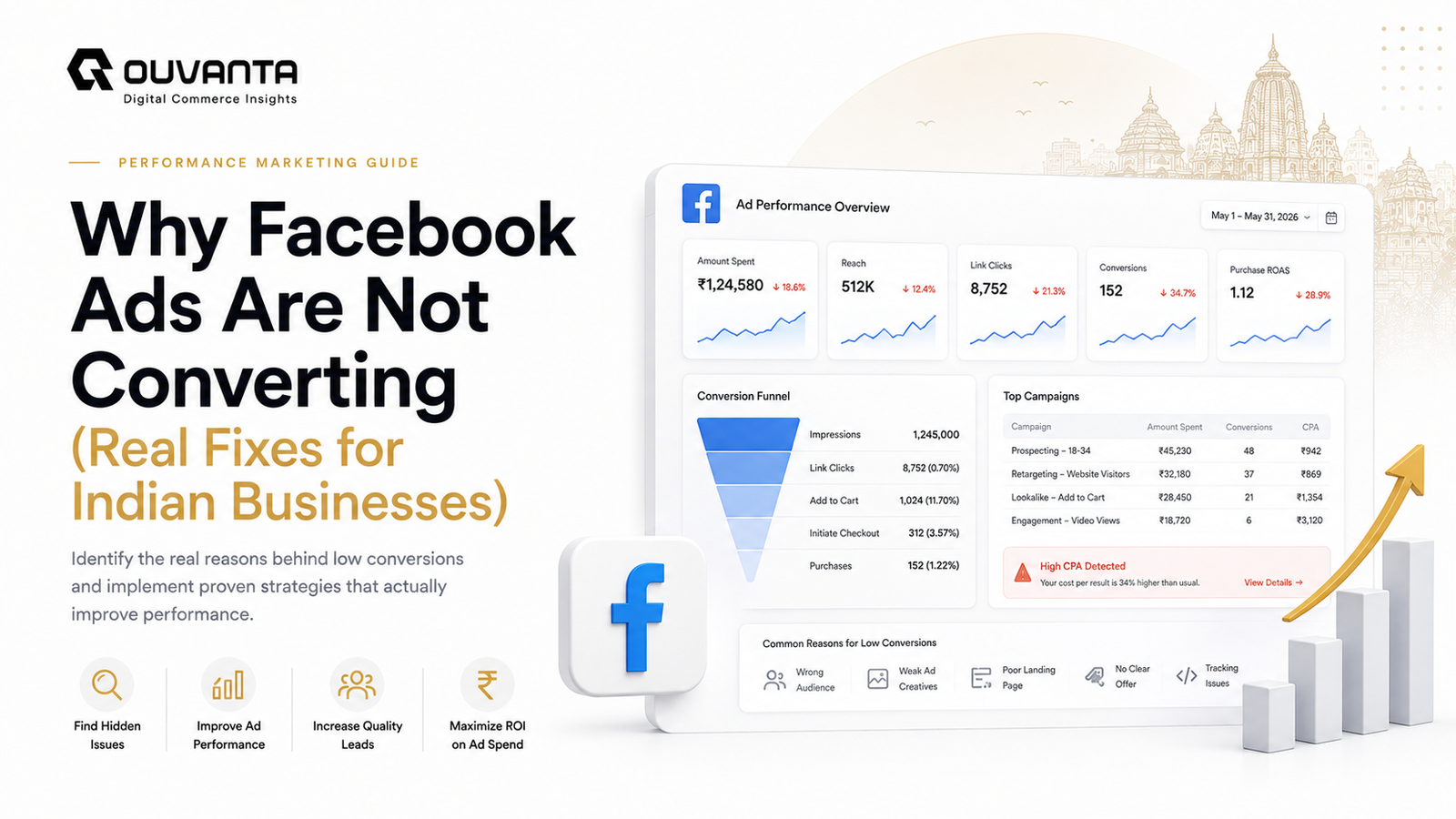
Your Facebook Ads are running. Money is leaving your account daily. And you're getting clicks — maybe even a lot of them. But the leads aren't coming, or the ones that come don't answer the phone, or they're completely wrong for your business.
Before assuming the platform doesn't work or your market isn't on Facebook — it almost certainly is — let's look at the actual problems. Most Facebook Ads failures in India are structural. They come from specific, diagnosable mistakes that have specific fixes.
Wrong campaign objective
This is the most common cause of zero or poor leads, and it's often the least obvious to non-specialists.
When you choose a campaign objective in Meta Ads Manager, you're telling the algorithm what kind of person to find. Choose "Traffic" and Meta optimises for people who click links. Choose "Reach" and it optimises for maximum impression volume. Choose "Leads" and it optimises for people statistically likely to fill out a form.
These are meaningfully different audiences. A person who clicks links is not necessarily a person who enquires about your service. When businesses run Traffic campaigns expecting leads, they get clicks — often cheap ones — from people who had no intention of enquiring.
Fix: If you want leads, use the Lead Generation objective (which shows a native Meta form) or the Conversions objective (which optimises for your website form submission). Don't use Traffic or Reach campaigns for lead generation.
The landing page problem
The ad gets someone to click. The landing page determines whether they enquire. Most businesses optimise the ad obsessively and ignore the landing page entirely.
Signs your landing page is the problem:
- Your ad has a reasonable click-through rate (1.5%+) but almost nobody fills the form
- You're sending traffic to your homepage rather than a page specifically about what was advertised
- Your landing page takes more than 3 seconds to load on a mobile phone
- The form asks for more than 3–4 fields (name, phone, email, one question)
- The page has no clear single call-to-action — multiple competing links, menus, and options
Someone who clicks an ad for "interior design services in Bhubaneswar" and lands on a homepage with navigation links to twelve different pages will leave. The connection between what they clicked and what they're now looking at is broken.
A landing page that converts 8% of visitors generates 4x more leads than one that converts 2%, from the same traffic and the same ad spend. Most businesses focus entirely on reducing cost per click rather than improving this number.
Fix: Create a dedicated landing page for each campaign — or at minimum each service. Remove the navigation menu. Have one clear offer, one form, one call-to-action. Reduce form fields to the minimum necessary. Test your page load speed on a 4G mobile connection.
Audience targeting problems
Three specific audience problems appear repeatedly in Indian Meta Ads accounts:
Too broad Running a campaign targeting "all adults in India" with general interest targeting is not targeting — it's broadcasting. Meta will find the cheapest impressions, which are often the least qualified people. Tighter audiences cost more per impression but convert dramatically better. Audience overlap If you're running multiple ad sets targeting similar audiences, they compete against each other in the same auction. This inflates your costs and confuses the algorithm. Use Meta's Audience Overlap tool to check before launching multiple ad sets. No retargeting layer Running only cold-audience campaigns means every person seeing your ad has never heard of you. Most people need 3–5 touchpoints before enquiring. A retargeting campaign targeting website visitors, video viewers, and page engagers delivers leads at 40–60% lower cost than cold campaigns alone. Tip: For local businesses in Bhubaneswar or specific Odisha cities, radius targeting (3–10km around a location) combined with relevant interests often outperforms broader demographic targeting. Local intent plus local targeting is a powerful combination.
Stuck in the learning phase
Meta's algorithm needs data to optimise. Specifically, it needs roughly 50 conversion events per week at the ad set level before it can reliably identify the best audiences and delivery times. This is called the learning phase.
Below 50 conversions per week, the algorithm is essentially making educated guesses. Above it, it has enough signal to optimise properly.
Two things keep campaigns stuck in learning:
- Insufficient budget. If your ad set budget is ₹500/day and your cost per conversion is ₹300, you'll get about 1–2 conversions per day — nowhere near the 7 per day needed to exit learning within a week.
- Too many changes. Every significant edit to an active campaign (budget changes above 20%, new creatives, audience changes) resets the learning phase. Businesses that constantly tweak campaigns never let the algorithm stabilise.
Fix: Either increase budget to generate enough weekly conversions, or switch to a higher-funnel event (like "View Content" or "Lead") that occurs more frequently. And stop making daily edits — let campaigns run for at least 7 days before evaluating.
Creative fatigue you haven't noticed
Frequency — the average number of times someone has seen your ad — is one of the most undermonitored metrics in Indian Meta Ads accounts.
When the same 50,000 people have seen your ad 7 or 8 times, they've stopped seeing it. Your cost per click rises because fewer people are responding. Your cost per lead rises as a result. But in Ads Manager, the campaign still looks "running" — you don't get a warning that says "your audience is exhausted."
Signs of creative fatigue:
- Click-through rate declining week over week
- Cost per lead rising while budget stays constant
- Frequency above 3.0 for a cold audience campaign
- You haven't changed creatives in more than 3–4 weeks
Fix: Refresh creatives every 3–4 weeks for active campaigns targeting smaller audiences. Test new angles, new hooks, new formats (static vs video vs carousel). Don't change everything at once — test systematically so you know what's working.
Broken conversion tracking
This one is silent and devastating. Your campaign reports conversions. You think it's working. But the conversions being counted are the wrong events — or they're double-counted — or the form is submitting but the Pixel isn't firing on the thank-you page.
How to check:
- Submit your own lead form and see if the conversion appears in Events Manager within 24 hours
- Use Meta's Pixel Helper browser extension to verify events are firing correctly on your landing page
- Check if conversions in Ads Manager match lead submissions in your CRM or email inbox
- Verify you haven't accidentally created duplicate Pixels or duplicate events
Worth noting: iOS 14+ privacy changes significantly degraded Pixel tracking accuracy. Businesses that haven't set up the Conversions API alongside the browser Pixel are missing a significant portion of conversion signals. Meta now recommends using both.
Budget and campaign structure issues
Two structural problems that compound everything else:
Too many small ad sets Splitting ₹1,000/day across six ad sets of ₹167/day each gives the algorithm almost nothing to work with in each ad set. Consolidate. Fewer ad sets with larger individual budgets outperform many small ad sets in almost every test. CBO vs ABO confusion Campaign Budget Optimisation (CBO) lets Meta distribute budget across ad sets dynamically. Ad Set Budget Optimisation (ABO) gives each ad set a fixed budget. CBO generally outperforms ABO at scale, but ABO is better for testing specific audiences or creatives when you need controlled data. Using the wrong one for the situation wastes budget.
If you're struggling with campaigns that aren't converting, getting an objective audit of the account is often the fastest path to answers. Our Meta Ads management includes an account audit as the first step — book a free review and we'll identify exactly which of these problems is affecting your campaigns.
Understanding what you're paying per lead compared to benchmarks is also useful context — see our Meta Ads cost guide for India for industry-specific CPL ranges.
Questions people ask
The most common causes are: wrong campaign objective (Traffic instead of Leads or Conversions), a landing page that doesn't match the ad or converts poorly, a form with too many fields, or broken conversion tracking. Check these four things systematically before assuming the audience targeting is the problem.
Give any new campaign at least 2–3 weeks before evaluating. The first week is the learning phase where the algorithm is gathering data. Results in week one are rarely representative of steady-state performance. Make significant decisions based on data from weeks 3–4 onwards.
It varies significantly by industry. Home services: ₹150–₹500. Healthcare: ₹120–₹400. Real estate: ₹300–₹1,200. Education: ₹80–₹300. B2B: ₹400–₹2,000. If you're paying more than 2x these ranges after a month of optimised campaigns, the structural issues in this article are worth investigating.
Sudden performance drops are usually caused by one of: creative fatigue (frequency too high, audience exhausted), algorithm reset from campaign edits, seasonal competition increase pushing CPMs up, iOS attribution changes reducing visible conversions, or a landing page technical issue. Check each systematically.
Facebook Lead Ads (native forms) typically have a lower cost per lead because they reduce friction — no page load required. But the lead quality is often lower because the barrier is so low. Website landing pages with a form deliver fewer but higher-intent leads. Test both for your specific business and customer type.
Yes. India has the largest Facebook user base in the world, and advertising costs remain lower than comparable Western markets. The platform works well for lead generation across almost every consumer category when campaigns are set up correctly. The issue is rarely the platform — it's almost always campaign structure, creative, or post-click experience.
Share this article
If you want this done for you
Sources
Platform behaviour and thresholds referenced above come from the official documentation. Cost figures are drawn from live accounts in the Indian market and are stated as bands, not averages.
- About the learning phase — Meta Business Help Centre
- About the Conversions API — Meta Business Help Centre
- About ad auctions and delivery — Meta Business Help Centre