Google Ads Cost in India (2026): Real Benchmarks
Google Ads is one of the most intent-driven advertising channels available. It's also one of the easiest to overspend on if you don't understand how the auction works. Here are real cost benchmarks for India in 2026.
Google Ads has a straightforward premise: someone searches for something you sell, your ad appears, they click, and if your offer is good they become a customer.
The execution is considerably more nuanced — and the gap between a well-run Google Ads account and a poorly-run one isn't 10% or 20%. It's often 3–5× in cost per lead for the same number of conversions.
This guide covers what Google Ads actually costs in India in 2026, which benchmarks matter, and where most businesses lose money without realising it.
How Google Ads pricing works
Google Ads runs a second-price auction. You set a maximum bid for a keyword, Google weighs that bid against your Quality Score, and the result determines both your ad position and what you actually pay.
Quality Score is a 1–10 rating based on three things: your expected click-through rate, the relevance of your ad to the keyword, and the experience on your landing page. A high Quality Score means you pay less than a competitor with a lower score, even if their bid is higher.
What this means in practice: Two advertisers bid ₹100 for the same keyword. Advertiser A has a Quality Score of 8. Advertiser B has a Quality Score of 4. Advertiser A wins the auction and pays less per click. Better relevance is cheaper.
This is why the businesses that win at Google Ads don't necessarily have the largest budgets. They have tighter keyword targeting, better ad copy, and landing pages that actually match what people are searching for.
CPC benchmarks by industry in India (2026)
Google Ads CPC in India varies enormously by industry because competition for valuable keywords drives prices up. A keyword like "buy insurance online" has dozens of well-funded advertisers bidding against each other. A keyword like "interior designer Bhubaneswar" has significantly fewer.
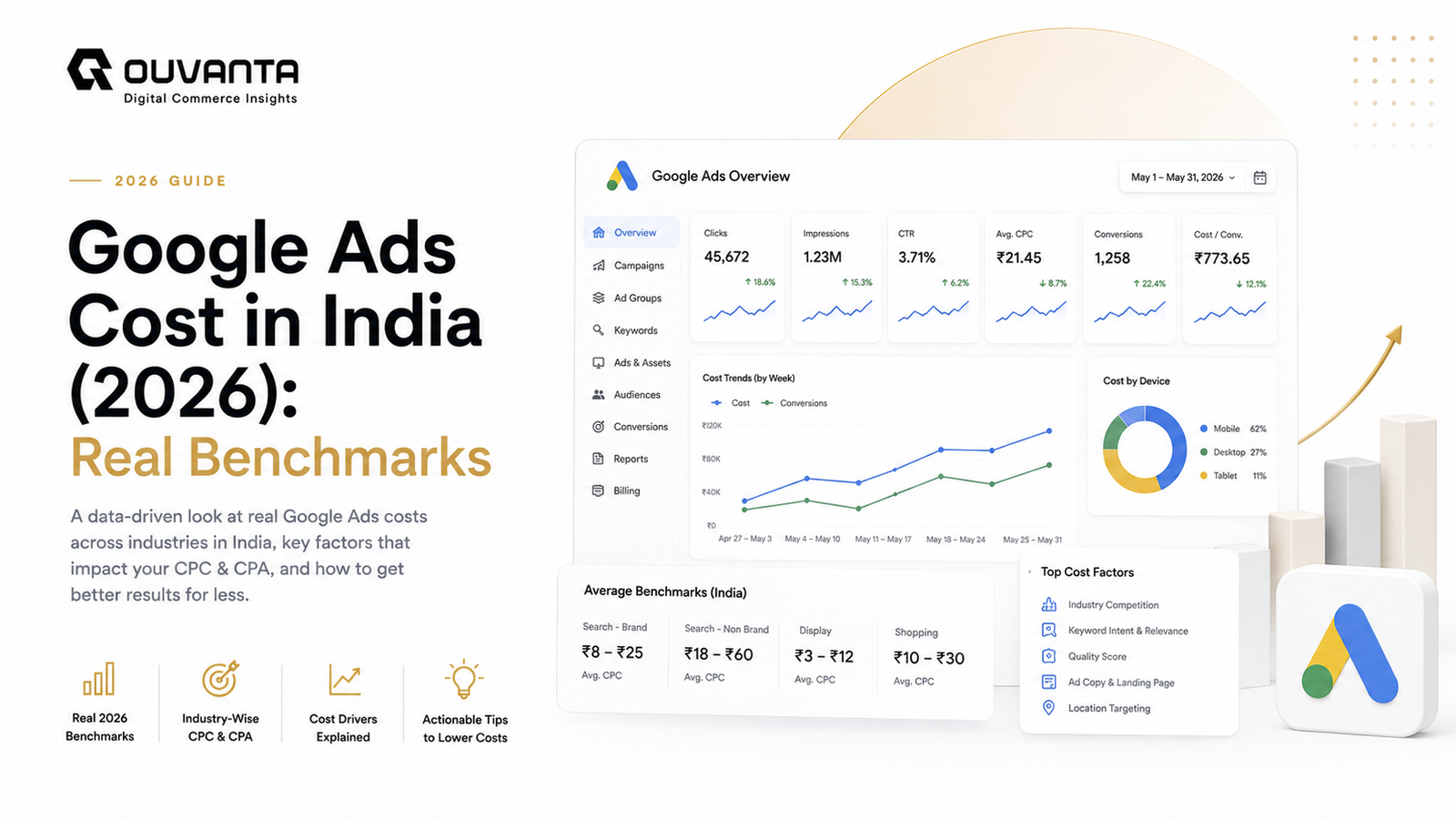
Average CPC by industry — India Legal services ₹80 – ₹350 per click Finance and insurance ₹60 – ₹280 per click Real estate ₹40 – ₹200 per click Healthcare (clinics, hospitals, doctors) ₹25 – ₹150 per click Education and coaching ₹15 – ₹90 per click Home services (interior, renovation, pest control) ₹12 – ₹70 per click B2B software and services ₹30 – ₹180 per click Ecommerce and retail ₹8 – ₹60 per click
Local keywords — those that include a city or region name — typically cost less than national equivalents because you're competing with fewer advertisers. "CA firm Bhubaneswar" costs less than "CA firm India." This is an advantage for businesses targeting specific cities in Odisha and Eastern India.
What about branded keywords?
Bidding on your own brand name typically costs ₹2–₹15 per click — far cheaper than generic industry keywords — because you're the most relevant advertiser for your own name. If competitors are bidding on your brand (common in competitive categories), owning your branded terms protects your traffic and is almost always worth the small cost.
What budget do you actually need?
Unlike Meta Ads, Google Ads doesn't have the same "algorithm learning phase" requirement. But you still need enough budget to gather meaningful data and to actually win enough auctions to appear consistently.
A practical way to estimate: if your target CPC is ₹50 and you want 20 clicks per day to test conversion rates, you need ₹1,000/day or roughly ₹30,000/month. That's before any management fee.
₹10,000 – ₹20,000/month Works for very narrow local targeting — specific keywords in a specific city. You'll appear inconsistently and miss many searches. Useful for initial testing, not for reliable lead generation. ₹20,000 – ₹50,000/month Viable for most local service businesses. Enough to run a focused campaign on high-intent keywords for a specific region and gather conversion data within 30–60 days. ₹50,000 – ₹2,00,000/month Full city coverage across a category. Multiple keyword groups, proper ad scheduling, and enough volume to test ad variations and landing page elements systematically. ₹2,00,000+/month National or multi-city targeting. Display, Demand Gen, YouTube, and Performance Max campaigns alongside Search. Full-funnel Google presence.
For website development and SEO services, which often pair naturally with Google Ads, see our website development cost guide and our SEO services overview.
Quality Score and why it matters
Quality Score is the most underestimated cost lever in Google Ads. Moving from a Quality Score of 4 to 7 on a keyword can reduce your effective CPC by 30–40%.
Here's how Quality Score affects your actual cost. Google's formula means a higher Quality Score multiplies the efficiency of every rupee you spend:
Quality Score impact on CPC Quality Score 3 (poor) Pay up to 400% more than the base rate per click Quality Score 5 (average) Pay the estimated base rate Quality Score 7 (good) Pay approximately 28% less than the base rate Quality Score 10 (excellent) Pay approximately 50% less than the base rate
Improving Quality Score comes from three things: writing ads that match the keyword tightly, getting people to click those ads (which signals relevance), and sending them to a landing page that directly addresses what they searched for. None of these require increasing budget.
Keyword intent and wasted spend
The single biggest source of wasted Google Ads spend in India is bidding on keywords without understanding what the searcher actually wants.
Keyword intent falls into roughly three categories:
Informational intent "How to start a business in India" — the searcher wants information, not a service. Expensive to bid on and almost never converts to a paying customer the same day. Avoid unless you're running a content strategy. Navigational intent "Quvanta media Bhubaneswar" — the searcher knows the brand they're looking for. Bidding on competitors' brand names can work but has mixed results. Bidding on your own brand name is always worthwhile. Commercial intent "digital marketing agency Bhubaneswar" or "meta ads agency near me" — the searcher is actively looking for a provider. These keywords cost more but convert dramatically better. This is where most of your budget should go.
We've audited accounts spending ₹80,000/month on Google Ads and found 60% of spend going to informational keywords that were never going to generate enquiries. The fix was narrowing to commercial-intent keywords and using negative keywords to block the rest — and it reduced spend by 40% while increasing leads.
Negative keywords — terms you explicitly exclude from your campaign — are as important as the keywords you target. Adding "free," "how to," "what is," and similar informational modifiers as negatives prevents your budget from reaching people who are researching, not buying.
Google Ads vs Meta Ads in India
A common question is whether to run Google Ads or Meta Ads. The more useful framing is understanding what each one does differently.
Google Ads captures demand Someone is actively searching for what you offer. They have a defined problem and are looking for a solution. Your ad appears at that exact moment. High intent, higher cost. Meta Ads creates demand You reach people who match your ideal customer profile before they're actively searching. You interrupt their feed with a relevant offer. Lower intent initially, but can reach people who would never have searched for you.
For most Indian service businesses, Google Ads is the faster path to leads from people who are ready to buy. Meta Ads is better for building awareness, retargeting website visitors, and reaching buyers earlier in their decision process.
The most effective approach uses both: Google Ads for bottom-of-funnel demand capture, Meta Ads for top-of-funnel reach and retargeting. For more on Meta Ads costs, see our Meta Ads cost guide for India.
Common Google Ads mistakes in India
These are the patterns we see most consistently in accounts that are spending but not generating enough leads:
- Using broad match keywords without negative keyword lists. Broad match in India can trigger for searches in regional languages, completely different industries, or questions that share a word with your keyword. Without negatives, your budget leaks into irrelevant searches quickly.
- Running campaigns 24/7 without ad scheduling. If your business is only staffed to handle enquiries from 9am–7pm Monday to Saturday, running ads and paying for leads generated at 2am on Sunday is wasteful. Ad scheduling ensures your spend aligns with when you can actually respond.
- Sending traffic to the homepage. Someone who searched "interior designer Bhubaneswar" and clicks your ad should land on a page specifically about your interior design services in Bhubaneswar. Your homepage serves everyone. A dedicated landing page serves this specific searcher. Conversion rates typically improve 2–4× with proper landing pages.
- Ignoring the conversion tracking setup. Many accounts run on "website visits" as their conversion event because nobody configured proper tracking. This means the algorithm is optimising for the wrong thing. Getting phone calls and form submissions properly tracked is essential before spending any meaningful budget.
- Letting Performance Max campaigns run without asset group refinement. Performance Max is Google's fully automated campaign type. It works, but without carefully curated asset groups and audience signals, it often targets audiences that are too broad and underperforms compared to a well-structured Search campaign.
Our Google Ads management service handles setup, keyword research, Quality Score optimisation, and ongoing management for businesses in Bhubaneswar and across India. If you're currently running ads and not sure where the spend is going, book a free account audit.
Questions people ask
Google Ads CPC in India ranges from ₹8 to ₹350+ per click depending on industry and keyword intent. Legal, finance, and real estate keywords cost the most. Retail and local service keywords are typically cheaper. Local keywords (with city names) cost less than national equivalents because there's less competition.
A realistic starting budget for most Indian businesses is ₹20,000–₹50,000/month in ad spend. Below ₹20,000/month you'll appear inconsistently and the data will be too thin to make reliable decisions. Budget requirements depend on your industry's CPC and how many clicks you need to generate meaningful conversion data.
Quality Score (rated 1–10) directly affects how much you pay per click. A Quality Score of 7 can reduce your CPC by around 28% compared to average. A Quality Score of 3 can increase it by up to 400%. Improving Quality Score by writing tighter ads and building relevant landing pages is the most effective way to reduce Google Ads costs without cutting budget.
They serve different purposes. Google Ads captures existing demand — people actively searching for what you offer. Meta Ads creates demand — reaching people before they're searching. Google Ads typically generates faster conversions for bottom-of-funnel searches. Meta Ads builds awareness and reaches buyers earlier. Most businesses with meaningful budgets benefit from running both.
Cost per lead depends entirely on your industry, location, and the quality of your campaign. Home services might target ₹200–₹500 per lead. Real estate ₹500–₹2,000. The right target is determined by your customer value and margins, not industry averages. A lead costing ₹1,000 that converts to a ₹50,000 project is far cheaper than a ₹200 lead that never answers the phone.
Yes, and local businesses in Bhubaneswar often have an advantage because competition for local keywords is lower than in metro cities. A plumber, interior designer, or clinic in Bhubaneswar faces less competition for their specific keywords than the equivalent business in Bangalore or Mumbai. This means lower CPCs and potentially better ROI at the same budget.
Share this article
If you want this done for you
Sources
Platform behaviour and thresholds referenced above come from the official documentation. Cost figures are drawn from live accounts in the Indian market and are stated as bands, not averages.
- How Google Ads works and how you are charged — Google Ads Help
- About the ad auction and Ad Rank — Google Ads Help
- About Quality Score — Google Ads Help